


How to Choose the Right Coupling: A 7-Step Guide for UAE Industry
Nov 19, 2026
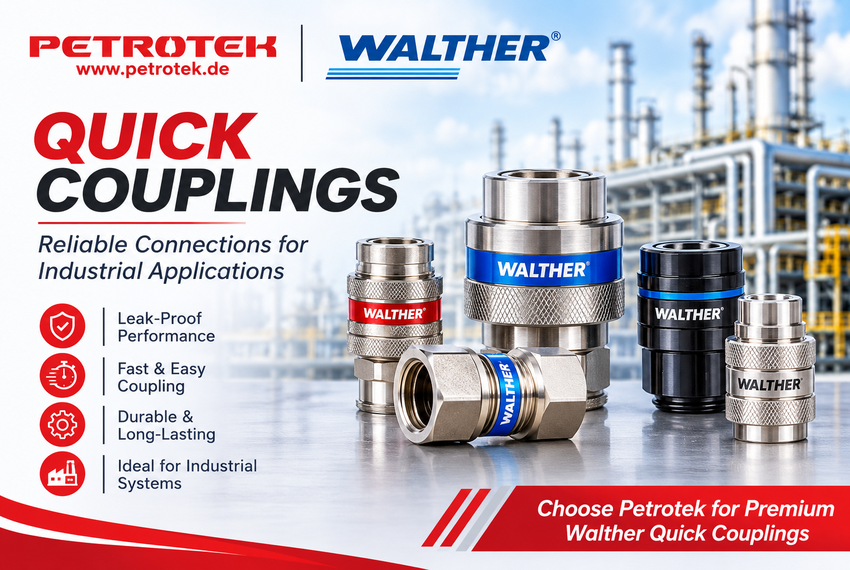
The wrong coupling rarely fails on day one. It fails months later, as a slow leak, a blown seal or a hose that pops off under pressure. Knowing how to choose the right coupling from the start saves downtime, fluid and money. This guide walks through the seven questions to answer before you order, and shows which WALTHER-PRÄZISION coupling fits each job. Petrotek is an authorised Walther Präzision distributor in the UAE, so you can get the right coupling and advice in one place.
Step 1: Know what flows through the line
Start with the medium, because it decides the coupling's body and seal material.
Hydraulic oil and lubricants: steel or stainless steel bodies with NBR or FKM (Viton) seals.
Water and cooling water: brass or stainless steel, with EPDM seals.
Chemicals and solvents: stainless steel with a seal checked against the chemical, such as FKM or PTFE.
Compressed air: brass or steel couplings rated for pneumatic pressure.
Breathing air: a dedicated breathing air coupling, never a standard air coupling.
Gases such as hydrogen: a coupling built and certified for that gas.
If you are unsure about a seal, send Petrotek the fluid's name or data sheet and we will check compatibility.
Step 2: Match the pressure class
Choose a coupling rated for the highest pressure your system can reach, including pressure spikes, not only its normal working pressure. Walther builds mono-couplings in four pressure classes:
Step 3: Check the temperature
Seals have temperature limits. In the UAE, outdoor lines and equipment can run far hotter in summer than the same system in Europe. Hot oil, steam and process lines need a high-temperature coupling with seals rated for the heat. Confirm both the medium's temperature and the surrounding air temperature.
Step 4: Decide how much spillage you can accept
Every standard coupling releases a small amount of fluid when disconnected. If that is a problem, choose:
Clean break couplings, built so that almost no fluid escapes on disconnection.
Non-spill couplings, designed for zero leakage during connection and disconnection.
These are the right choice for chemicals, pharmaceuticals, food processing and any clean area.
Step 5: Think about safety
Some lines need a coupling that cannot come apart, or be connected, by mistake.
Coded couplings stop breathing air or medical gas lines from being connected to the wrong supply.
Locking couplings prevent accidental release under pressure. The Walther HG series hydrogen coupling uses double locking for this reason.
Emergency-release couplings separate safely if a hose is pulled, for example by a moving vehicle.
ATEX-compliant couplings are needed in explosive atmospheres such as oil, gas and chemical sites.
Step 6: Size the connection
Check the nominal size, the thread or connection type on both sides, and the flow rate you need. A coupling that is too small restricts flow and creates pressure drop. Note your hose size, thread standard (for example BSP, NPT or UNF) and flow rate before you ask for a quote.
Step 7: Count the lines and check standards
If operators connect several lines to one machine or mould, a multi-coupling connects them all in one movement and prevents mix-ups. Automated lines and robots can use docking systems or TOOLmaster tool changing systems, which connect all media automatically.
Finally, check which standards your site or client requires, such as ATEX for hazardous areas, SAE J2601 for hydrogen refuelling, or FDA-compliant materials for medical and food use.
Get the right coupling from Petrotek
As an authorised Walther Präzision distributor in the UAE, Petrotek can match a coupling to your exact application. Our team in Business Bay, Al Quoz and Musaffah will check the medium, pressure, size and standards for you. See our full range of Walther Präzision couplings in the UAE.
FAQ
What is the most important factor when choosing a coupling?
Start with the medium and the maximum pressure. They decide the coupling's material, seal and pressure class. Then check temperature, spillage, safety and size.
What is the difference between a clean break and a standard coupling?
A standard coupling releases a small amount of fluid when disconnected. A clean break coupling is built so that almost no fluid escapes, which suits chemicals, oils and clean areas.
Can I use a normal air coupling for breathing air?
No. Breathing air lines need dedicated breathing air couplings, ideally coded, so they cannot be connected to industrial air or other gases.
Can I mix couplings from different brands?
It is not recommended. Couplings that look similar may not seal or lock properly together. Use matching halves from the same range.
Which pressure ratings do Walther couplings cover?
Walther mono-couplings cover low pressure up to 100 bar, medium pressure up to 250 bar, clean break up to 650 bar and high pressure up to 3,000 bar.
Where can I get help choosing a coupling in the UAE?
Petrotek is an authorised Walther Präzision distributor in the UAE. Call +971 4 289 6166 or visit our showrooms in Al Quoz, Dubai and Musaffah, Abu Dhabi.